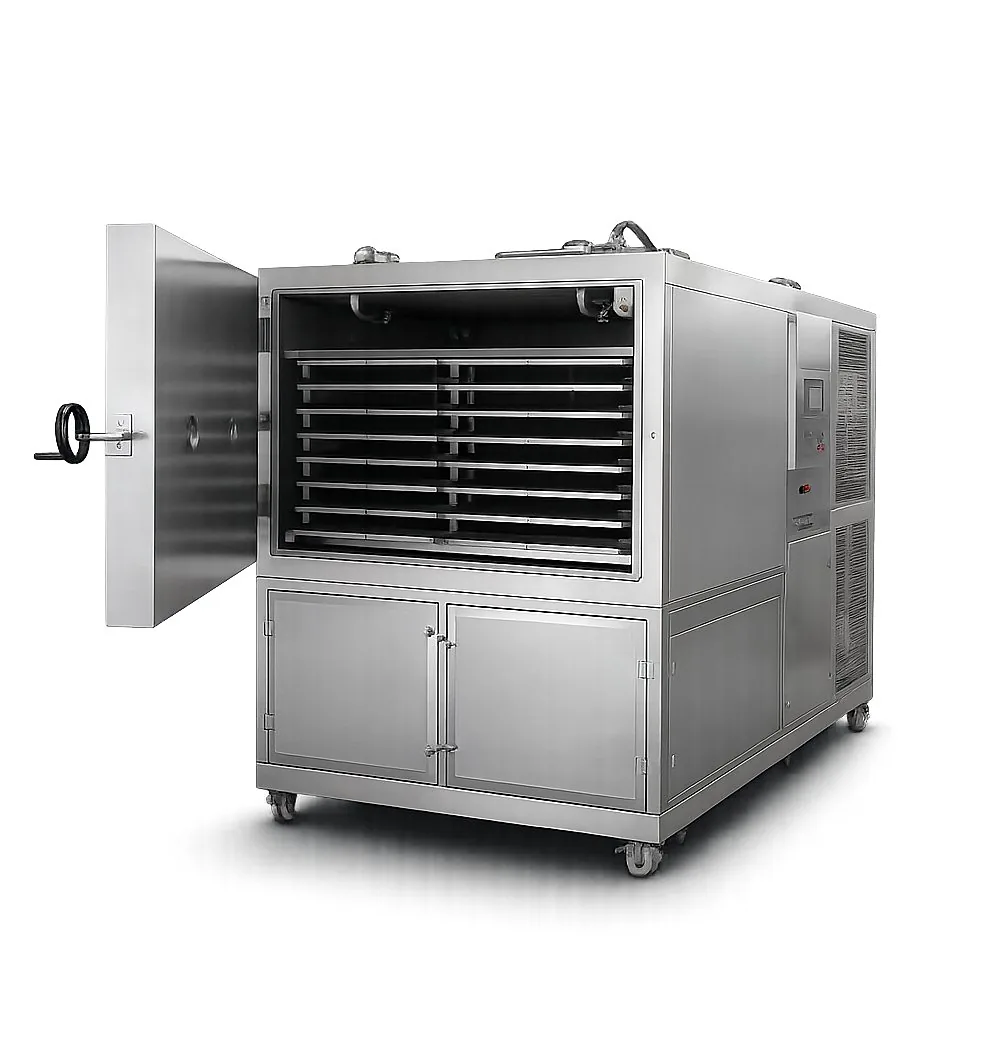
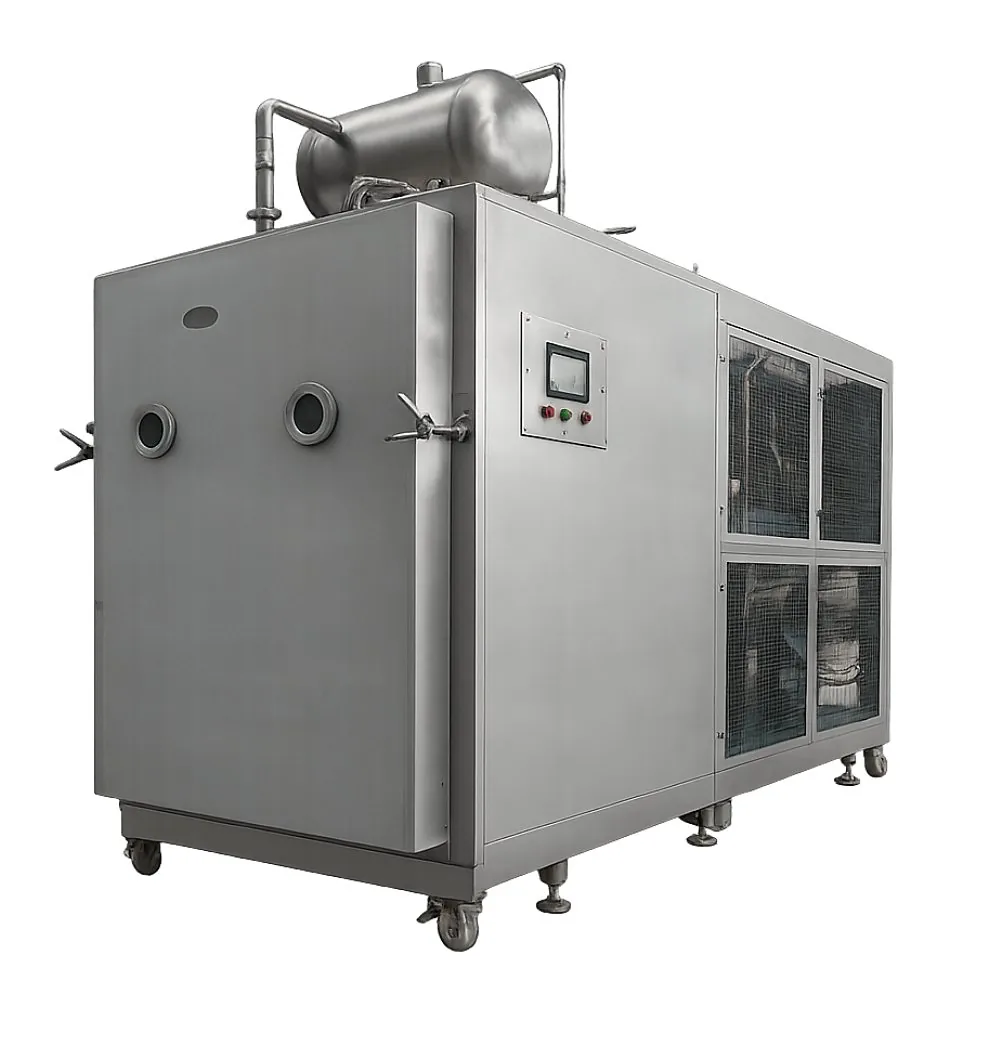
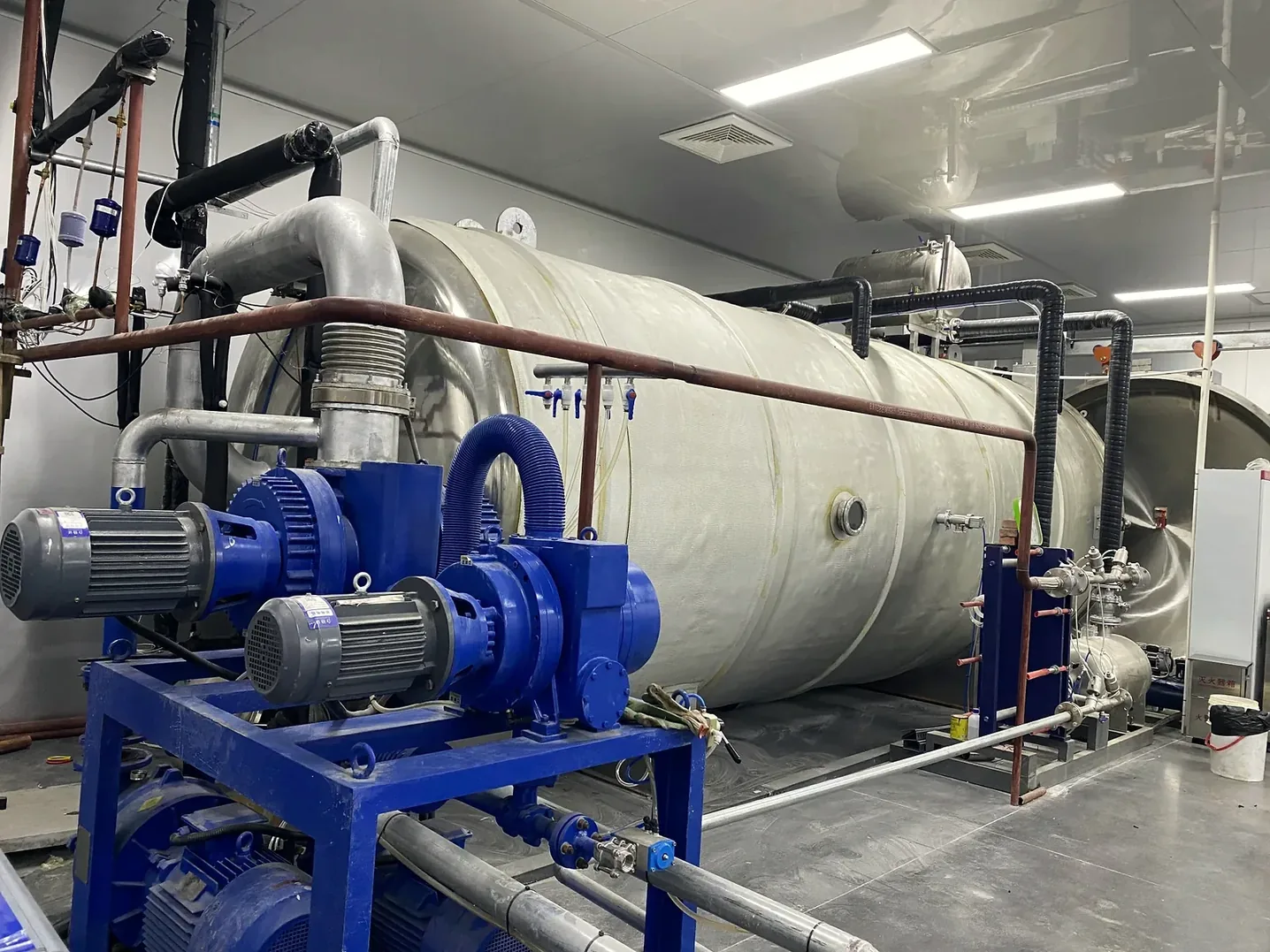
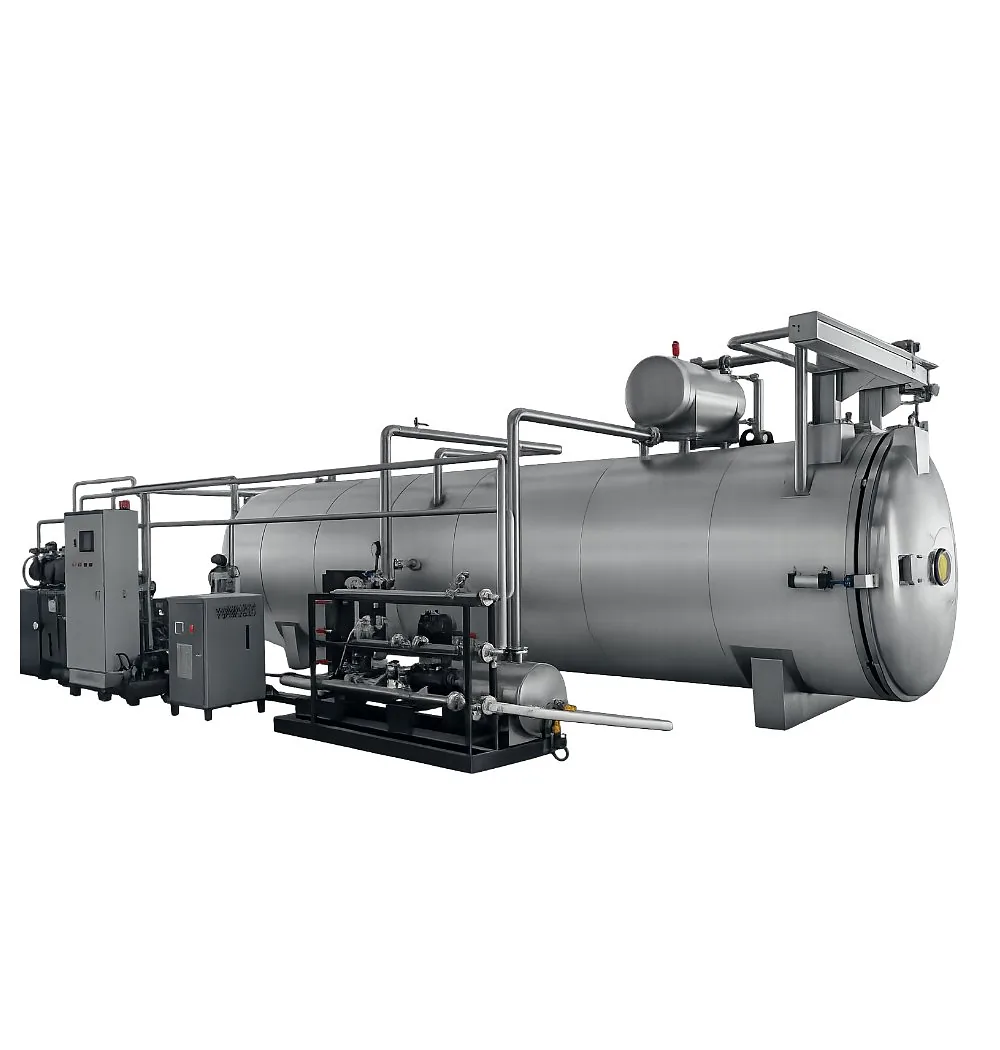
From a 10 m² all-in-one to a 202 m² split-type industrial system, sized by drying area and water capture per batch. Figures from each model's quotation; final values per technical agreement. When you are ready to buy, our guide to importing an industrial freeze dryer from China covers factory checks, the technical agreement and acceptance tests.
| Model | Drying area | Water / batch | Power | Structure | Weight |
|---|---|---|---|---|---|
| FD-10 | 10 m² | 120 kg | 25 kW / 380V / 50Hz | All-in-one | 3000 kg |
| FD-20 | 20 m² | 300 kg | 39 kW / 380 V / 50 Hz | All-in-one | 4500 kg |
| FD-30 | 30 m² | 400 kg | 75 kW / 380V / 50Hz | Split type | 7000 kg |
| FD-60 | 60 m² | 600 kg | 100 kW / 380V / 50Hz | Split type | On request |
| FD-100 | 100 m² | 1200–1300 kg | 170 kW / 380V / 50Hz | Split type | On request |
| FD-200 | 202 m² | 2400–3000 kg | 350 kW / 380V / 50Hz | Split type · freezing room included | 28000 kg |
Water / batch is water capture: the water the condenser can take in a batch. It is not the wet load you put on the trays, and it is not the mass of dried product. Finished mass depends on how much water the material started with, and on what remains after drying — neither is fixed by the FD-20 catalogue water-capture rating of 300 kg.
Illustration (method only, not a tested FD-20 strawberry batch). 100 kg of strawberries at 85% moisture hold about 85 kg of water and about 15 kg of solids. Tray loading, slice thickness, residual moisture, losses and cycle time are not given, so this is not a daily output or an energy figure. The FD-20 FAQ uses the same method. Send the material and moisture with the other sizing details below; that is an enquiry, not a finished load figure.
Not sure which model? Tell us your material and daily target and an engineer will advise.
Tell us:
The product catalogue describes process validation as testing the material and defining the drying curve and capacity. Until a trial exists for that material, water capture is not a throughput figure, and we do not publish a cycle time, kWh per batch, or payback for that product. Send the details above so a model can be sized against that material.
Commercial and industrial vacuum freeze dryers — the machine stays the same; the water inside the product changes. These are the factors our engineers look at before recommending a configuration.
Slices, dice, whole berries, purée
Colour, shape and crunch survive, and the piece rehydrates close to fresh.
Sugar lowers the temperature at which the structure can collapse, so heat is applied more gently.
Consistent slice thickness. Uneven pieces finish at different times on the same tray. See fruit & vegetable freeze dryers.
Dice, slices, leaves, blanched pieces
Green colour and volatile aroma hold up far better than in hot-air drying.
Very high starting moisture means a large water load per kilogram of fresh input.
Blanching before freezing for many vegetables, to stop enzymes changing colour and flavour. See fruit & vegetable freeze dryers.
Cubes, strips, shrimp, sea cucumber
Protein structure is kept without cooking, and the dry product is light to ship.
Piece thickness and fat content: fat does not sublimate and slows vapour escape.
Uniform piece size, and the food-safety controls your market requires for raw or cooked product.
Frozen extract broken into granules
Aroma that heat-based drying drives off stays in the cup.
Extract concentration set upstream decides how much water the dryer has to remove.
The whole line: roasting, extraction and freezing shape the final quality as much as the dryer. See a real coffee line.
Raw meat pieces, organs, complete-diet nuggets
Raw nutrition is kept and the product is shelf-stable without preservatives.
Piece size and fat, then loading density on the tray.
Pathogen control for raw materials, agreed with your food-safety team before scale-up. See pet food freeze dryers.
Concentrates and solutions in trays
Viability depends on never letting the material warm past its critical temperature.
A narrow allowed product temperature, so shelf heating ramps slowly and precisely.
Shelf-to-shelf temperature uniformity and documented batch records.
How heat reaches the shelves is one of the biggest decisions for running cost. It follows from the model size and the utilities at your site.
| Heating | Models | How it works | Best when |
|---|---|---|---|
| Electric | FD-10, FD-20 | All-in-one cabinet; connect water and power and run. | R&D, small production, sites without steam |
| Steam | FD-30, FD-60, FD-100, FD-200 | Plant steam heats the shelves; the electrical load is reduced. | Industrial sites that run, or can add, a boiler |
Every freeze dryer, drying and IQF model with specifications, build standards and what we need for a quotation. 6 pages, 1 MB.